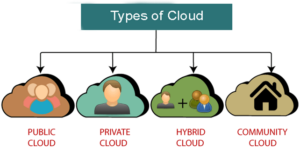
Cloud computing offers various deployment models to suit different business needs and requirements. The main types of cloud deployments are:
1. Public Cloud:
In a public cloud, computing resources are provided and managed by third-party service providers over the internet. These resources are made available to the general public or any organization that wishes to use them. The infrastructure, applications, and data are hosted on the service provider’s servers, and users can access them through the internet. Public clouds offer cost-effectiveness, scalability, and ease of use since the provider handles the maintenance and management of the underlying infrastructure.
Examples: Amazon Web Services (AWS), Microsoft Azure, Google Cloud Platform (GCP).
2. Private Cloud:
A private cloud is dedicated to a single organization and is operated solely for that organization’s use. It can be located on-premises or hosted by a third-party service provider but is not shared with other organizations. Private clouds are chosen by businesses that require more control, security, and compliance with specific regulations or have stringent data privacy concerns.
3. Hybrid Cloud:
A hybrid cloud is a combination of public and private clouds, allowing data and applications to be shared between them. It enables organizations to take advantage of the benefits of both cloud types, such as the scalability of the public cloud and the security of the private cloud. Hybrid cloud setups are helpful for businesses that have sensitive data or specific applications that they prefer to keep in a private environment while using the public cloud for other non-sensitive workloads.
4. Community Cloud:
A community cloud is shared among several organizations that have similar interests or needs, such as security requirements, compliance regulations, or industry standards. This deployment model allows these organizations to pool resources, infrastructure, and costs to meet their common goals effectively.
Each type of cloud deployment has its advantages and is chosen based on factors such as security, control, scalability, and budgetary considerations. Organizations often opt for a mix of these cloud models, depending on their specific use cases and objectives.