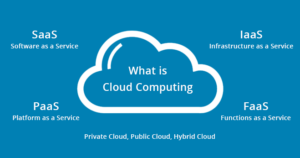
The Cloud, in the context of computing, refers to a network of remote servers hosted on the internet that store and manage data, applications, and services. It allows users to access and utilize computing resources over the internet, rather than relying solely on their local hardware and software. The term “cloud” comes from the representation of the internet as a cloud in network diagrams.
Cloud computing services can be broadly categorized into three main types, known as the Cloud Service Models:
1. Infrastructure as a Service (IaaS):
IaaS provides virtualized computing resources over the internet. Instead of purchasing and managing physical servers and networking equipment, users can rent virtual machines, storage, and networking resources from cloud service providers. This gives users more flexibility and scalability as they can quickly scale up or down based on their needs. Examples of IaaS providers include Amazon Web Services (AWS), Microsoft Azure, and Google Cloud Platform (GCP).
2. Platform as a Service (PaaS):
PaaS offers a platform that allows developers to build, deploy, and manage applications without having to worry about the underlying infrastructure. Developers can focus solely on writing code and let the cloud provider handle everything related to the operating system, hardware, and networking. PaaS is well-suited for software development and testing, as well as web application hosting. Popular PaaS offerings include Heroku, Microsoft Azure App Service, and Google App Engine.
3. Software as a Service (SaaS):
SaaS delivers software applications over the internet on a subscription basis. Users can access these applications through a web browser without having to install or maintain the software locally. SaaS is widely used for various purposes, such as productivity tools (e.g., Google Workspace, Microsoft Office 365), customer relationship management (CRM) systems (e.g., Salesforce), and collaboration software (e.g., Slack, Zoom).
Additionally, there are some other variations and combinations of cloud services, such as:
– Function as a Service (FaaS) or Serverless Computing: FaaS allows developers to execute functions in the cloud without managing the underlying infrastructure. Developers write code to perform specific tasks, and the cloud provider takes care of scaling and executing the code as needed. AWS Lambda and Azure Functions are examples of FaaS platforms.
– Container as a Service (CaaS): CaaS provides a platform for developers to deploy, manage, and scale containers, such as Docker containers, without worrying about the underlying infrastructure. Kubernetes is a popular CaaS platform.
Each of these cloud service models offers distinct advantages and is suitable for different use cases. The flexibility, scalability, and cost-effectiveness of cloud computing have made it an essential technology for individuals and businesses alike.